


26 May University of Algarve Presents RESILCROPS Research at International Workshop on Rugulopteryx okamurae in Ceuta
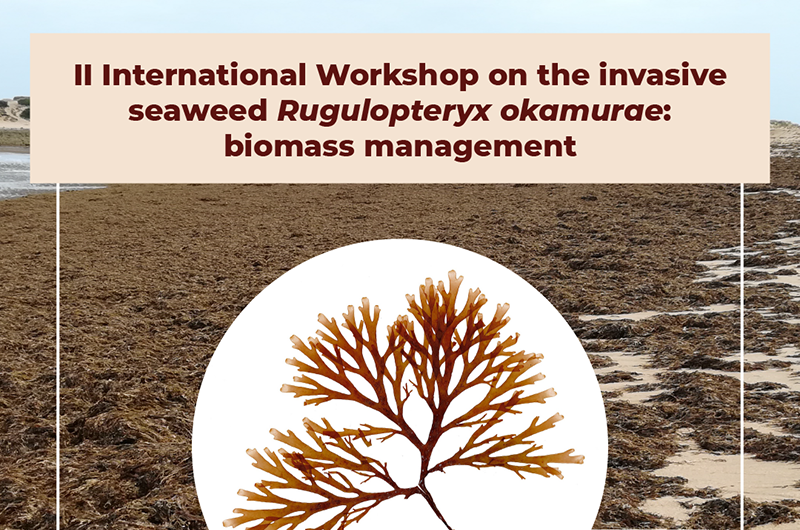
Researchers from the Universidade do Algarve participated in the 2nd International Workshop on the invasive seaweed Rugulopteryx okamurae, held from 11 to 13 May at the Faculty of Health Sciences of the University Campus of Ceuta, Spain.
The event brought together scientists, technicians, and environmental managers from Spain, Portugal, Italy, and Colombia to discuss the ecological impact of this invasive species and explore sustainable strategies for managing the large amounts of biomass generated along Atlantic and Mediterranean coasts.
During the workshop, the University of Algarve presented the scientific poster “Rugulopteryx okamurae along the Algarvian coast”, showcasing several research activities currently being developed within the RESILCROPS project.
The poster highlighted the participatory monitoring initiative “Alga na Praia / Seaweeds on the Beach”, coordinated by CCMAR (Centre of Marine Sciences of Algarve), which combines citizen science approaches with standardized observation protocols to improve knowledge of the distribution and expansion of Rugulopteryx okamurae along the Algarve coast.
The presented work also addressed the potential valorisation of the invasive biomass through biotechnology and circular economy approaches. Research activities include microbiological analyses, the isolation of marine microorganisms associated with the algae, and the evaluation of bioactive compounds and biostimulant applications for more resilient and sustainable agriculture.
These activities are part of the RESILCROPS project (Harnessing Circular Economy to Improve Crop Resilience in the Atlantic Area), an initiative funded by the Interreg Atlantic Area Programme 2021–2027. The project promotes the development of natural biostimulants derived from algae and microorganisms to enhance crop resilience against climate change-related stresses. (resilcrops.com)
The participation of the University of Algarve in this international workshop reinforces RESILCROPS’ commitment to scientific collaboration, environmental sustainability, and the development of innovative circular economy solutions for the Atlantic Area.